
Call Before Traveling to Rayville
Confirm that the file is onsite, ask for the current copy and certification charge, and learn which identifiers staff need before making the trip. Published courthouse parking, security, recording, and accessibility details were not located, so ask about current entry procedures and accommodations during the same call.
Mayor’s Court or 5th JDC?
Not every criminal-looking local record belongs in the Richland Parish district-court index. Louisiana R.S. 33:441 gives a mayor’s court jurisdiction over violations of municipal ordinances. Rayville, Delhi, and Mangham can therefore preserve ordinance and traffic proceedings that never become a Fifth Judicial District Court felony or state-law misdemeanor file. A municipal attachment for failure to appear may likewise remain with the issuing mayor’s court rather than appear as a searchable 5th JDC prosecution.
Route the inquiry by identifying the issuing agency, the wording on the citation or notice, and the alleged law. A reference to a town ordinance, mayor’s court, municipal ticket, or local docket points toward the municipality. A bill of information, indictment, state statute, or Fifth Judicial District Court docket points toward the Richland Parish Clerk. Rayville and Delhi had no official online mayor’s-court lookup located during research. Mangham’s municipal profile confirms a mayor’s court and supplies the town telephone, 318-248-2170, but no public case portal.
If the record’s home is unclear, call the Richland Clerk with the full name and approximate year and ask whether a district docket exists. Then contact the municipality that issued the ticket or attachment. Do not assume that paying through a court or traffic link immediately recalls a warrant; confirm that the issuing court has posted the action. This routing step saves a trip to Rayville and prevents a no-result in one court from being treated as proof that no local matter exists.
Criminal Court Cases in Richland Parish
The Fifth Judicial District Court hears Richland Parish felony and state-law misdemeanor prosecutions. The district also serves Franklin and West Carroll parishes, but the Richland Parish Clerk preserves the Richland docket, pleadings, minute entries, judgments, sentences, and certified copies. The district website supplies judges, rules, calendars, and courthouse contacts; it is not a replacement for the clerk’s criminal index.
A police report, jail booking, prosecutor’s charging instrument, and court case are separate records. An intake charge can change after district-attorney screening. The filed bill of information or indictment identifies the accusation the court will address, and later charge-level entries show pleas and outcomes. Readers tracing an arrest into court can compare it with the county arrest search channels, but should treat the clerk file as the authority for the filed prosecution.
Searching Without a Public Richland Portal
The official Richland Parish Clerk of Court website is the starting point for local custody and contact information. During research, it did not expose a public criminal defendant search. Call 318-728-4171 before traveling. Give the full legal name, known aliases, an approximate filing or arrest year, and the docket number when available. Ask staff whether the matter is criminal, traffic, or a mayor’s-court proceeding, whether an older file is onsite, and what current plain-copy and certification charges apply.
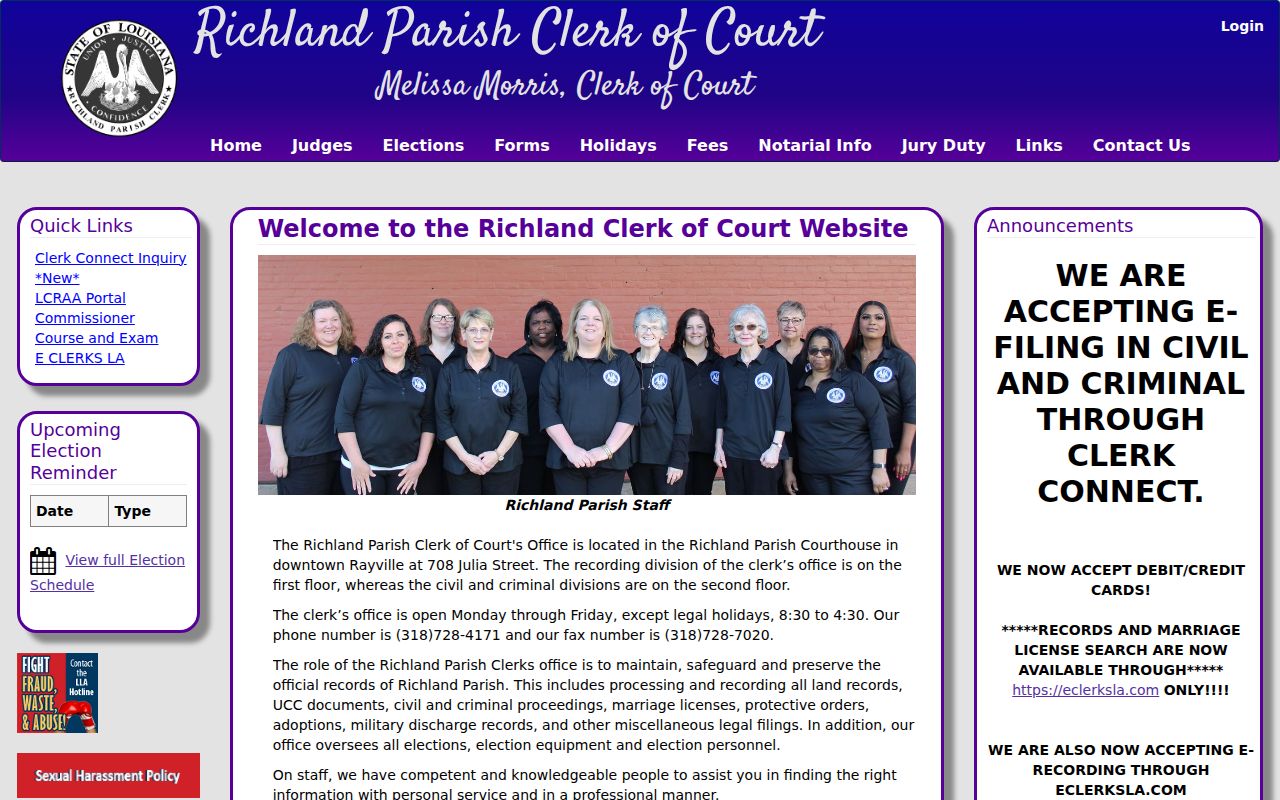
The clerk source is important because it directs the request to the actual custodian rather than an unofficial people-search index. No local fee schedule or processing promise was published, so request an estimate before copies are made.
Richland Parish Case Record Searches
Use the channels in the order that matches the record. Each one answers a different question:
- Call or visit the Richland Parish Clerk for a defendant-name index search, docket number, charge-level disposition, judgment, sentence, and copies.
- Use the Fifth Judicial District Court site for district rules, judges, and calendars, then confirm the official file with the clerk.
- Contact Rayville, Delhi, or Mangham for ordinance or traffic proceedings within a mayor’s court’s jurisdiction under R.S. 33:441.
- For federal prosecutions, search PACER in the Western District of Louisiana; federal dockets are not stored as Richland 5th JDC files.
- If seeking what Louisiana BCII associates with your own fingerprints, use Right to Review. It is a statewide history product, not a public court-case search.
| Search detail | Where used | Why it helps |
|---|---|---|
| Full legal name and aliases | Clerk index | Separates similar names and older spellings. |
| Docket or case number | Clerk and calendar | Identifies one prosecution precisely. |
| Approximate year | Clerk/archive request | Narrows active and archived files. |
| Division or judge | 5th JDC calendar | Helps locate scheduled proceedings. |
| Municipality | Mayor’s court | Routes ordinance matters outside the district docket. |
The 5th JDC’s Three-Parish Structure
The official Fifth Judicial District Court serves Richland, Franklin, and West Carroll parishes and identifies Judges John C. Hamilton, Will R. Barham, and Stephen G. Dean. A district-wide calendar can help establish when a matter is set, yet geography determines custody of the record. For a Richland prosecution, the Rayville clerk counter remains the source for the docket and copies.
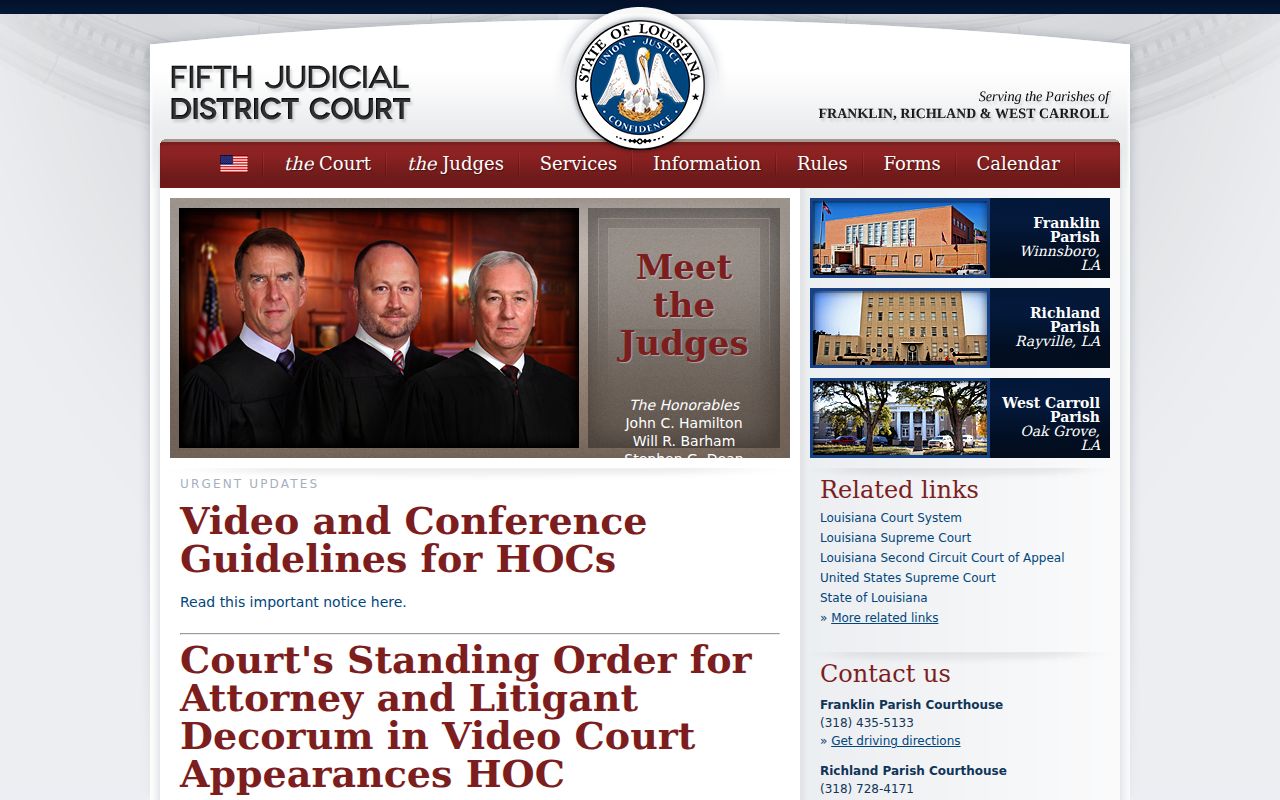
This distinction prevents a common mistake: treating a court calendar as the full case file. A calendar is scheduling evidence; the clerk’s minute entries and filed documents preserve what happened.
What a Criminal Case File Contains
A public file may contain the caption, docket number, filing and offense dates, division and judge, charge and statute, counsel, bond information, hearing dates, motions, pleas, minute entries, disposition, sentence, costs, restitution, warrants, and appeal activity. Availability varies by file and lawful redactions.
| Docket and caption | Unique case number and State-versus-defendant identification. |
|---|---|
| Charging instrument | Bill of information, indictment, or other filed accusation after screening. |
| Proceedings | Arraignment, hearings, discovery and motion activity, continuances, plea or trial. |
| Disposition | Outcome for each count, including conviction, dismissal, nolle prosequi, acquittal, or another status. |
| Sentence | Custody, suspended time, probation, fines, restitution, costs, and conditions ordered. |
| Document access | Plain or certified copies, subject to confidentiality, sealing, and redaction rules. |
Read outcomes count by count. A multi-count case can contain a conviction on one allegation and a dismissal or nolle prosequi on another. “Dismissed,” “not guilty,” and “nolle prosequi” are not interchangeable.
Bill of Information, Indictment, and Booking Charge
A booking charge records the allegation used at intake. The district attorney may later decline it, amend it, or file a different statute in a bill of information. An indictment is a grand jury’s formal accusation where that process is used. Grand-jury deliberations remain secret even though a returned indictment enters the court record.
The difference matters when a roster and docket appear inconsistent. The booking describes custody at one moment; the charging instrument defines what entered court. The ultimate judgment and sentence provide the outcome. Matching all three by date, person, and docket number avoids treating an initial allegation as a final court result.
Criminal Case Stages in Richland Parish
Louisiana procedure commonly begins with arrest or summons, prompt probable-cause review and bond consideration, then district-attorney screening. After a bill of information or indictment is filed, arraignment records the plea. Discovery, motions, hearings, negotiation, and preparation follow. A plea or trial produces a result, the court enters judgment and sentence, and an appeal may follow.
Docket entries can be terse. Minute entries may summarize a hearing without attaching every pleading. Ask for the specific judgment, dismissal, plea minutes, or sentencing minutes needed rather than assuming the online calendar contains them.
Correcting a Missing Disposition at BCII
A Louisiana criminal-history cycle can remain incomplete when a disposition is delayed or identifiers do not match. Start with the clerk and obtain a certified judgment, dismissal, or other final disposition. Then follow Louisiana State Police BCII challenge instructions for your own Right to Review record. The clerk can certify its court document, but it cannot directly edit the state repository.
This workflow also clarifies why a dismissal does not automatically erase an arrest image or every index entry. Expungement is a separate court process. Accurate disposition reporting and removal from public access solve different problems.
Access Rules for Case Records
Louisiana Public Records Law begins at R.S. 44:1, but public does not mean unredacted. Juvenile matters, sealed or expunged records, grand-jury material, protected victim and minor information, medical details, Social Security numbers, financial-account numbers, and active-investigation information may be withheld or redacted. A custodian should provide a segregable public portion when the law permits.
Louisiana expungement removes covered records from public access rather than destroying them. Eligibility depends on the charge, disposition, waiting period, prior history, and statutory exclusions. Article 977 addresses qualifying misdemeanors and article 978 qualifying felonies; filing occurs in the court holding the record.
The official Article 983 fee allocation documents a standard total that can reach $550, divided among BCII, the arresting agency, district attorney, and clerk, while waivers and exceptions may apply.
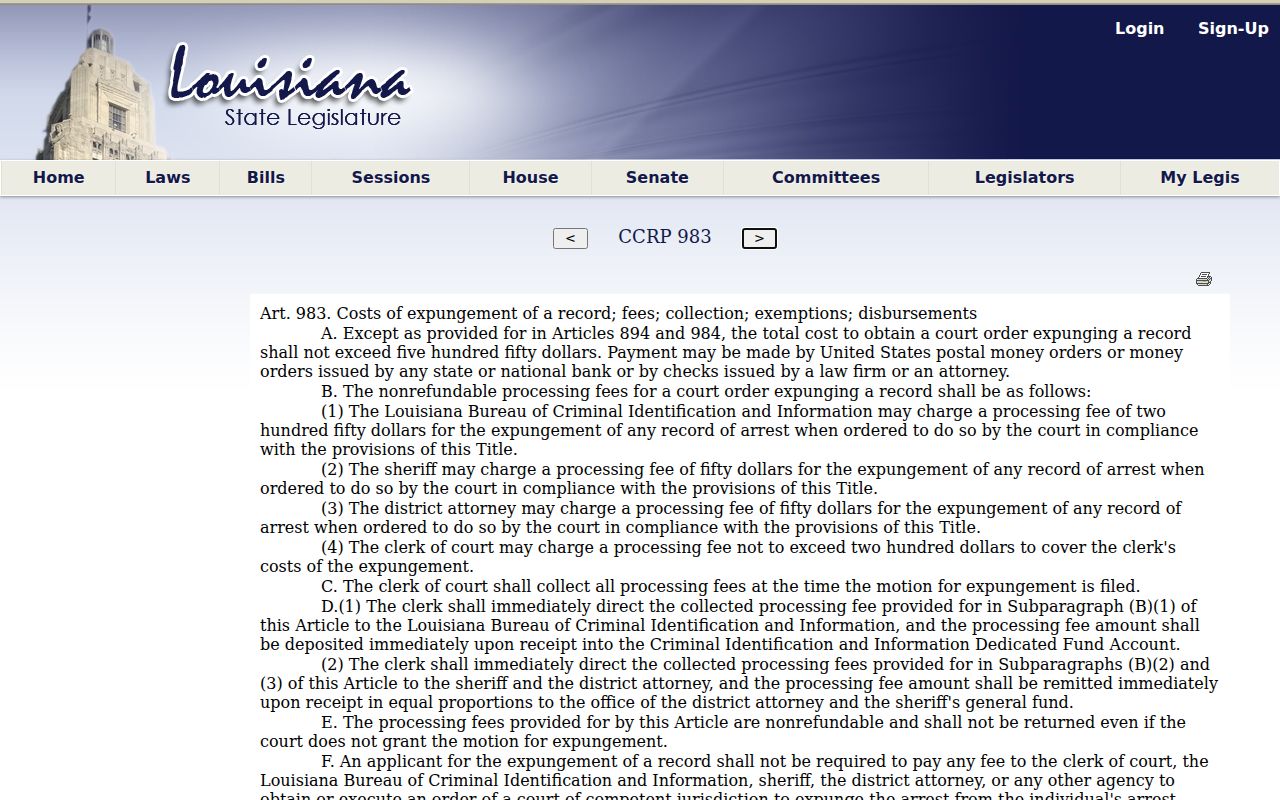
The statute image grounds the fee discussion in the enacted source; the clerk should still confirm the current amount and whether a statutory exemption applies to a particular filing.
Misdemeanor and Felony Expungement Routes
The Louisiana misdemeanor expungement eligibility law sets the Article 977 framework and its exclusions.
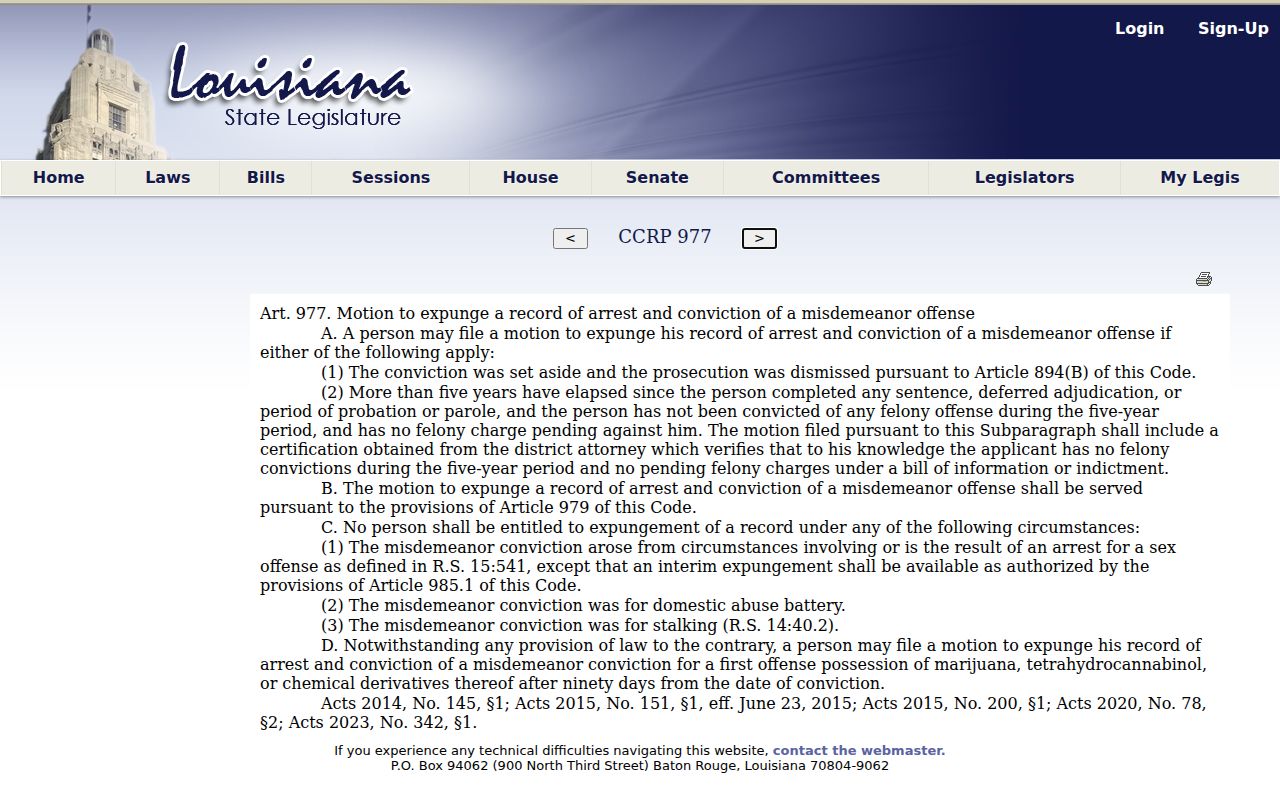
That source helps a requester separate an eligible outcome from a mere dismissal assumption; the actual Richland docket and certified disposition remain necessary.
The Louisiana felony expungement eligibility law provides the distinct Article 978 route.
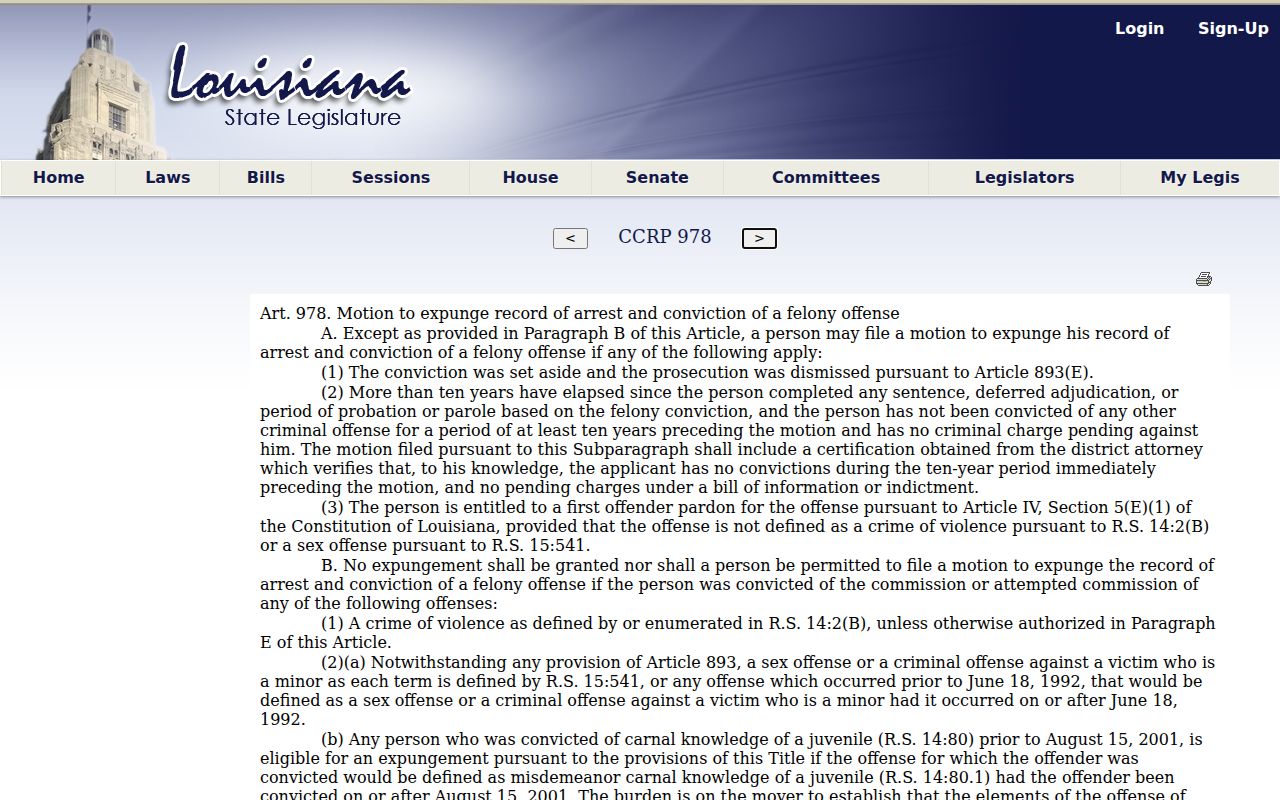
Felony eligibility is not inferred from a universal class table: Louisiana statutes assign penalties offense by offense. Confirm the exact statute, disposition, and sentence shown in the clerk file before evaluating relief.